Monday, July 23, 2012

Musical Instruments and Orthodontics

Does making sweet music cause changes to your bite?

A popular question heard by my staff and me when our musical patients begin their orthodontic treatment:

Question: What can I expect now that I have braces? Will it feel weird, or hurt? For how long?

Answer: We have seen many patients over the years adjust their embouchure in a week or two. Some use the reusable protective covers we have available. As the treatment progresses, they tell us it feels normal again.
 
A recent article* in the AJO-DO looked at a long held theory that playing a wind instrument can effect the position of your teeth. Well does it? An orthodontist and bassoonist - Dr. Strayer - and others, have proposed this theory. It certainly seems plausible, considering the forces distributed on the dentition when playing a trumpet, a clarinet, an oboe, and a flute, which all direct horizontal and vertical forces on the teeth.

Proffit's equilibrium theory of tooth movement was put to the test. The theory states that tooth movement requires a force application that exceeds minimum threshold to effect tooth movement. The effects of thumbsucking are well-documented in the literature.
 
The authors studied 4 groups of professional musicians, all of whom play or practice on average at least 3 hours per day. One group, who did not play wind instruments, was the control. Study casts were taken of their teeth. The results showed that teeth positions are not altered significantly when playing wind instruments, except when the musician plays a large cup-shaped mouthpiece like a trombone or tuba. These musicians are at a small risk of developing a lingual cross-bite. So as the risk of significant changes to a musician's teeth alignment is very low, we encourage you to continue to practice those wind instruments!
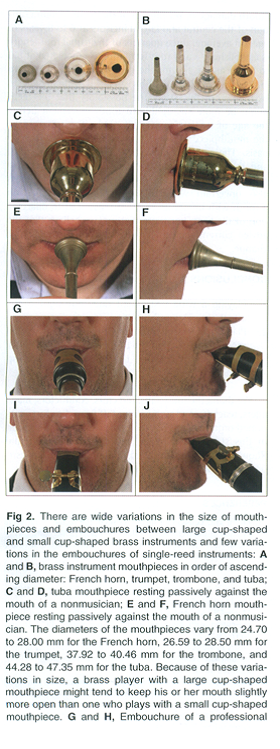


On a side note - Since they focused the study on wind instruments, there was no mention of violinists and the risk of developing posterior cross-bites in this study, or in the references. A friend of mine from dental school who played the violin was convinced that musical activity contributed to his posterior cross-bite.
 
Until next month-thanks for your time!
 
*Reference: Grammatopoulos, White, and Dhopatkar. Effects of playing a wind instrument on the occlusion. Am J Orthod 2012; 138-145.

Monday, June 4, 2012

Interview on Cool 101.3 & Eagle 97.7

In March Dr. Steckel had the opportunity to be interviewed by Norm Short of Cool 101.3 and Eagle 97.7.

The topics include:

1. Renovations of the Polytech High School Dental Assisting program, and teaching co-op students
2. Future conventions coming to Dover, DE,... AND
3. Orthodontics, of course!

Please Click Here to go to the Meet the Doctor page on our website to listen to the clip!

Thanks for listening. Talk to you next month!

Friday, May 11, 2012

The First and New Honorary Mayor of Central Delaware is also the manager for Orthodontics on Silverlake.
 
Steve Artz is excited and proud to represent OSL in this new role. He already has junior ambassadors-some from OSL- recruited and ready to serve!
 
Steve received a lot of support from our friends in the dental community, for which we are very appreciative.
 
His Motto: "If it's fun, it gets done"

His plans this year include:
 
1. Hosting the 2nd annual Dover Return Day and 1st annual Central Delaware Chamber of Commerce Return Day
 
2. Meeting with all the Mayors of Central Delaware for breakfast to hear and discuss important issues
 
3. Promoting good oral hygiene- samples and instructions whenever, wherever needed!

 
Congratulations Steve, and much thanks to our OSL team-members who gave him their incredible and unwavering support!
 

Joanna, Ryan & Dr. Steckel were there to celebrate with Steve on his winning night!
 

Friday, April 20, 2012

April is Facial Protection Month!

At OSL, my team and I regularly encourage all of our patients to wear facial protection during any contact sports.
 
April is National Facial Protection Month, and orthodontists along with oral surgeons and pediatric dentists are again reminding our athlete patients to take care to prevent injuries.

The AAO message (below) has been modified, to even include those on the sidelines (see #4):
 
  1. Wear mouth guards for contact sports to help prevent injuries to the teeth and mouth.
  2. Wear a helmet. Helmets absorb the energy of an impact.
  3. Wear protective eyewear. Eyes are extremely vulnerable.
  4. Be alert even as a spectator. Alert spectators can avoid foul baseballs and flying hockey pucks. Watch your step when climbing bleachers.

Education is best when it's fun and engaging. And when it's fun it's gets done- see below

 
Steve & Ryan at Super Science Day at Town Pointe Elementary

 
See you next month!


Friday, February 10, 2012

National Children's Dental Health Month - February 2012

The Delaware State Dental Society (DSDS) will host the 8th Annual "Give Kids a Smile" and provide free dental care two days this month-February 11th and February 17th, 2012. Volunteers from the DSDS will also provide education and any needed referrals in a fun and upbeat atmosphere for patients and their families.

Because of this event many children benefit and avoid more costly and possibly irreversible damage to their primary and permanent teeth. Parents and patients both are educated and encouraged to practice proper diet and home-care to reduce the need for future invasive dental treatment.

As an orthodontist I've seen some children at this event with developmental problems that need to be addressed as well.

In orthodontics there are genetic and environmental components to a malocclusion. In other words, there are conditions that are inherited and seen in a patient from a very early age, and others that develop over time.

Genetic components include:
1. Mandibular prognathism = Large lower jaw ("Hapsburg jaw")
2. Teeth size
3. Disproportionate size/shape of upper and lower jaws
4. Overbite (more significant genetically than overjet)

Environmental components include:
1. Muscular imbalances
2. Oral habits such as thumb or finger sucking
3. Diet choices, which can contribute to early tooth loss, and disruption of development
4. Overjet (more significant environmentally than overbite)

The individual attention I provide to a patient's dental age, chronologic age, and any irregularities in development are accomplished best before the permanent teeth have all erupted- before age 12 yrs. The attachment below shows images of conditions that should to be evaluated for proper timing of intervention, no matter the age of the patient:


Information Courtesy of the AAO

Monday, January 16, 2012

Choices, Choices! Invisalign® or Braces?

Frequent patient question @Orthodontics on Silverlake (OSL):

“Which should I choose-Invisalign® or Braces?

Answer: “It depends….”


The attached video produced by Align technology is short, and shows fun banter between twin sisters discussing the benefits of Invisalign® treatment over braces.

In my opinion both girls seem happy at the end of the video, as they should be; both of them are seeing their teeth get straighter. When used appropriately each treatment option is predictable over time. When the girls are finished they will each need retainers to maintain the results achieved.

Teen Invisalign® has been a great addition and advancement for all of the Invisalign® treatment options available to me as an orthodontist. Orthodontists (me included) were worried about compliance with Teens, so compliance indicators and eruption tabs were developed. Teens overall have been as responsible as our adult patients in caring for their aligners and achieving wonderful results.

FACT: I have yet to implement the ‘nuclear option’ for any teen patient due to lack of compliance!  

Braces (metal or ceramic) are still chosen by our patients -“they are always working” - as we’ve said and parents have said as well. There are lifestyle adjustments with Invisalign® and that sometimes sways patients to choose braces.

Final note- excellent oral hygiene, reduced sugars, sodas and sports drinks is paramount no matter what treatment option you choose.

Talk to you in February!

Thursday, November 17, 2011

"The Six Elements of Orofacial Harmony"

Continuing education is important for an orthodontist, for a variety of reasons. One recent CE experience for me was a great opportunity to meet one of the great minds in modern orthodontics: Dr. Larry Andrews. The course was the "The Six Elements of Orofacial Harmony."

Orthodontists treat more than teeth (Element VI), even though most patients who come to see me are concerned with their "overbite, crowded teeth, or gaps." We also need to evaluate (Elements I-V):
 
I. Arch shape and length
II. Jaw Positions
III. Jaw widths
IV. Jaw Heights
V. Chin Prominence

These Elements are routinely evaluated when I see patients, but sometimes not all 6 of these elements contribute significantly to a patient's orthodontic plan.
 
I have described Dr. Andrews' Six Keys to Occlusion many times to patients over the years when reviewing treatment results or discussing planned treatment. Over the two day course I attended earlier this month, it was enlightening to to look at orthodontic treatment records and planning through the Andrews' prism.  After attending the course I have implemented a few of his ideas. His son Will is in practice with him and shares the lecture duties and does a great job describing some of the trickier concepts relating to measuring tooth position based on a patient's forehead. Several orthodontic residency programs - West Virginia and U Penn, for example - are implementing the concepts into the orthodontic curriculum. The residents I met were very enthusiastic in their experiences to-date. Perhaps a visit to the San Diego office to continue my studies is in order? Talk to you next month!
 
                         Above: Dr. Steckel with Dr. Larry Andrews and his son Dr. Will Andrews